
Your Brand Guidelines Were Never Built for a Building
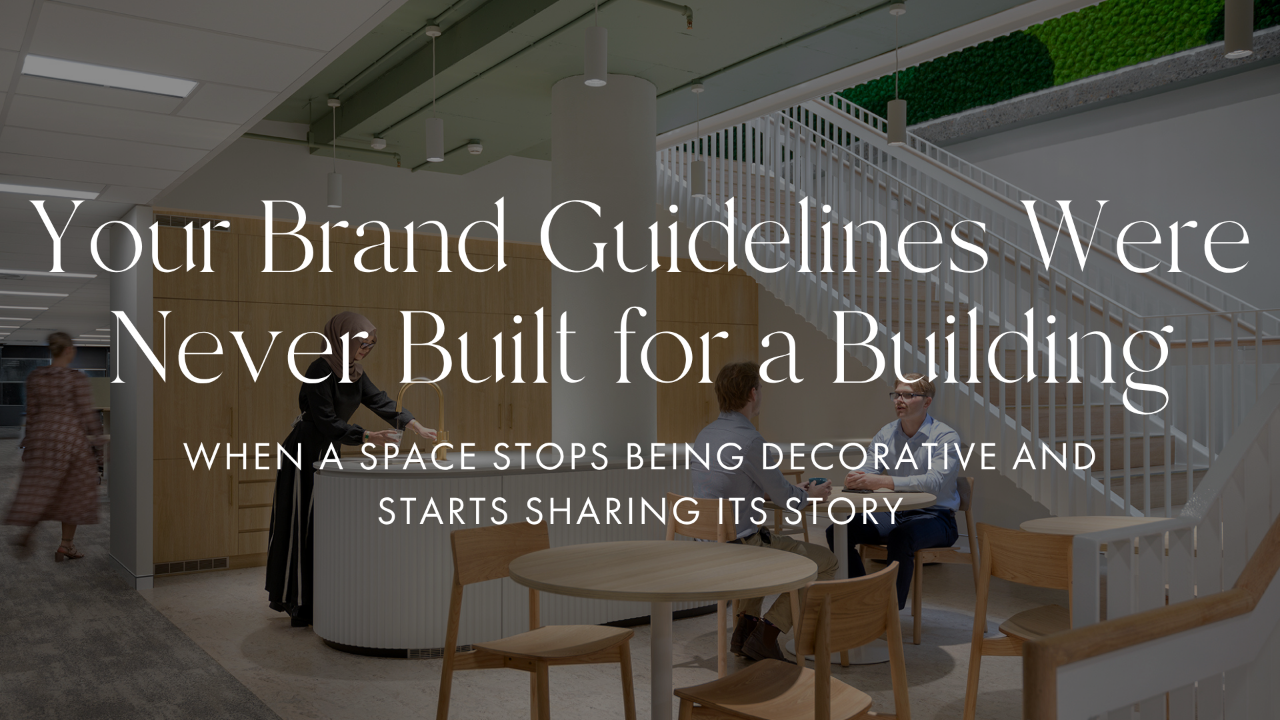
When a space stops being decorative and starts sharing its story.
I got goosebumps. A lump formed in my throat and my eyes started to well up.
That's when I knew we'd nailed it.
We'd been brought in on a facility that, at that point, was still just lines on a drawing board. The technical and functional aspects had already been scoped and documented; the construction detailing was sorted. But this building needed something else. It needed a presence. An impact. And that wasn't going to come from the architectural drawings alone.
The client had a beautifully articulated brand package; logo, colour palette, strong copy. But that deck had never been built for a physical space. It was built for marketing and print. It had nothing to say about how a person should actually feel standing in the room.
So instead of starting with the brand guidelines, we started with different questions.
Why does this space exist?
Who's going to move through it?
How does their life or career change because they did?
What do we want them to feel, see, hear, do?
Somewhere in that process, it landed. I felt it in my body before I could put it into words; my throat tightened, my eyes filled. Sitting in a workshop room, genuinely emotional, because it felt so true to who this organisation is and what they do for the people they touch.
That's the story and the experience we wanted others to feel.
The Myth I Keep Running Into
Here's one of my (not so) secret frustrations with this industry: people think "brand" means putting a logo on a wall and sticking rigidly to a Pantone palette.
When I ask a client to tell me about their brand, the first thing I usually get handed is a set of brand guidelines, with the expectation that this has answered everything, and the space is now just a matter of applying this logo, this colour, this pattern. Job done.
But a palette built for a website or a print campaign was never designed to hold a human experience. It wasn't built to make someone feel something as they walk through a door, round a corner, or arrive somewhere that matters to them.
This was never about putting a brand into a building. It's about designing an experience, where brand is one input among several, alongside organisational purpose, values, and the emotions of the real people who'll use the space. What do they need to feel? Where are they going, emotionally, by the time they leave?
Those are the questions that turn an empty space into one that means something. Colour and pattern might show up eventually, as an expression of that thinking, but they were never the starting brief. Most work in this space stops at "let's paint a feature wall in the brand colour." That's decoration wearing a brand's colours, not experience design.
How We Actually Get There
So how do you design an experience into a building before it's even built? Here's how we do it.
We start with a discovery workshop, not the usual "what are your brand colours" conversation, but a genuine dig into who this space is for, what you want them to feel, what you want them to do while they're in it. We use the twelve Jungian archetypes as one tool to help pin down the emotional register we're designing for. Brand language is an input here, but it's never the goal.
From there, we look for the words that describe the feeling, not the finish. As a team, we distil all of it into three or four core pillars; brand, purpose, people, place; compressed into the handful of ideas the space actually needs to communicate. Around each pillar, we mind map the periphery: the textures, materials, moments and metaphors that give an idea real depth. This is where the best sparks of imagination tend to show up.
None of this is linear, and you can't put a time limit on it. We play with ideas that, in the end, don't fit. We keep tweaking until the experience clicks, and, you know when it's right because you feel it. A tingling in your body. Goosebumps. That full-body yes is the sign.
Only once that story is locked down do we move from 2D to 3D, finding the images, textures and materials that bridge an idea into physical form. Then comes the final test: translating it into the built environment itself. A building was never one space. It's a series of consecutive moments; arrival, immersion, exit; delivered to a real person, moving through real space, in real time.
The Part Nobody Talks About
There's a moment in this job that never gets easier: the second right before you say the idea out loud.
We don't always talk about the parts of a project where it isn't working. On this one, we had a strong brief, a deep discovery workshop behind us, solid pillars, yet for a while, nothing was landing. The concept felt like it was almost there, but we couldn't put our finger on it. The words felt generic. Expected. Nothing about it felt unique or particularly moving.
I remember sitting in that team workshop feeling a bit deflated, wondering what we were missing. We just hadn't found it yet.
So, we went back to the start. Pulled on a few different threads. And then, there it was. The idea we'd been circling but couldn't quite grasp. This time, it landed. I knew, because I could feel it: a whole-body yes, goosebumps, a tightening in my throat, eyes welling up.
But then comes the part we don't talk about enough. Putting a concept like that in front of a client isn't really about the concept. It's you, fully exposed, sitting there in front of them. Nowhere to hide.
This is what clients actually engage us for. To take them beyond what they could have imagined themselves, and when you do this work with any real depth, you're not pitching a colour scheme. You're presenting an experience you've envisioned for people who don't yet exist, in a space that's still being created. Something you've poured genuine feeling into, that you believe is the truest representation of who they're aspiring to become. There's no professional version of "here's my heart and soul on the page, please don't crush it." They can love it, or they can hate it. There’s usually no in-between.
As I presented this strategy, I got choked up. I could still feel that same emotion in the words I was saying, because it felt like the strongest story I had to share for them, and I had no idea yet whether they'd see what I saw.
But thank God, they did.
They said they were blown away. Better than they thought we'd come up with. Better than they'd ever expected.
For a good ten minutes before that, though, I had absolutely no idea which way it would go.
What This Job Actually Is
Most "brand experience" work is interior decoration wearing a brand's colours; logo here, feature wall there, a bit of corporate pattern sprinkled over the top. What that approach misses is that the brand guide is only ever one part of the story, never the whole brief. Purpose. Story. The people who'll actually walk through that door, and what they need to feel. That's the real material.
Uncovering the real experience of a space takes a different way of thinking entirely. It's about finding out who this space needs to make the hero of their own story, then building a physical world that delivers that feeling to a real body, in real time.
That's not just a design skill. It's the willingness to put something honest on the table and let it be judged.
That's the actual job.
