
The Opportunity Cost of Treating Your Workplace Move as "Just a Move"
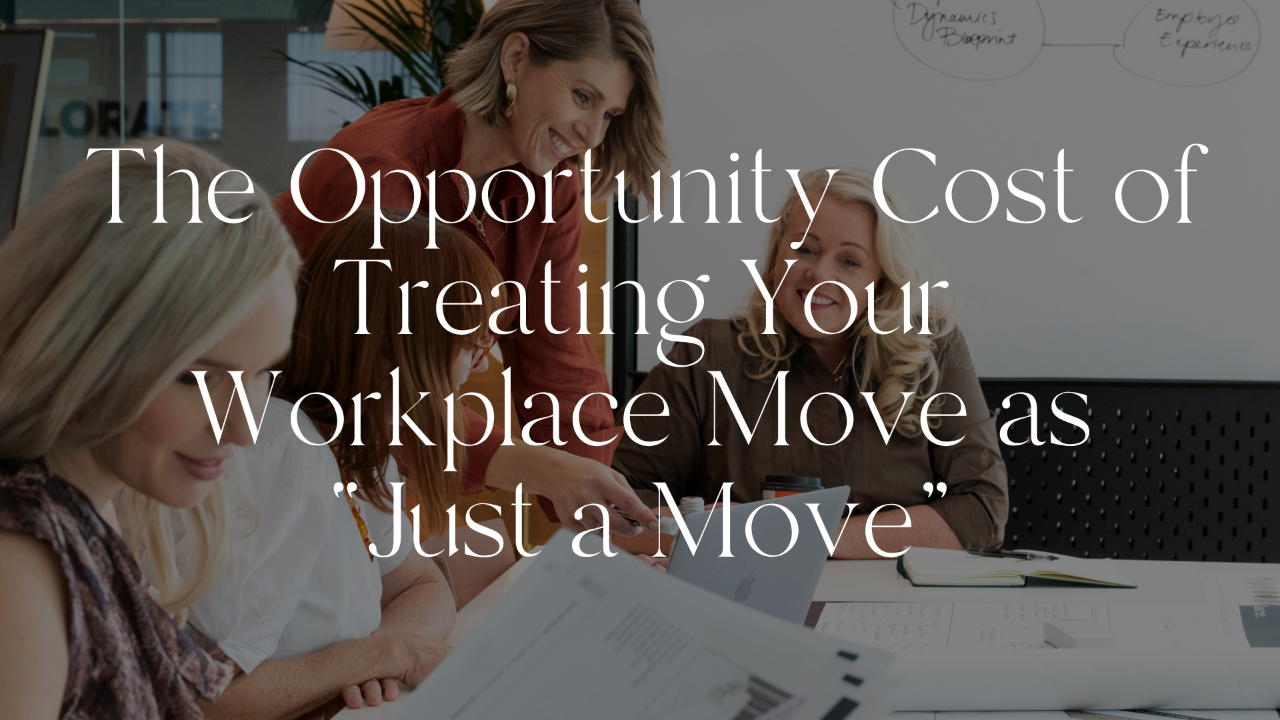
Last week we ran a change workshop with our client to support the move to their new workplace.
On paper, it could be considered a "simple" relocation. They're already hybrid, working in an unallocated seating model - no real new ways of working, in theory. New building not too far from the current, minimal commute disruption for most. Multiple floors consolidating down to one, with more space and better amenity. All good things, in the big picture.
But an hour into the workshop, it was clear how much there actually was to communicate, and how differently people needed to hear it.
Changes in workpoint quantities, workpoint styles, meeting rooms, collaboration space and quiet rooms all meant that even though these spaces already existed in some form, the ratios were different in the new environment. Different ratios mean new ways of working, whether anyone had framed it that way or not.
The people who are primarily desk-based five days a week have completely different questions and concerns to teams that are highly agile and collaborative. Leaders needed answers they could communicate with confidence, to establish strong team cohesion from the outset and stay on the front foot. "Simple" and "small" changes still impact everyone differently, and a few emails about the new end-of-trip facilities and the coffee machine were never going to cut it.
It was never just relocation comms
More than once, unprompted, the executive team raised that this was an opportunity to reset culture. To shift behaviours toward better engagement, new patterns of collaboration, stronger ways of working together.
If that opportunity is missed, because the focus stays on logistics instead of people, it's gone. This is a once-in-10+-year opportunity to break old habits and form new ones. That's a real cost, even if it never shows up on a spreadsheet. It's a missed opportunity cost, and that phrase came from their own CFO, not from us.
Why this keeps happening
I've seen this play out at other organisations too, and it follows a pattern.
They start down the process. They ask for the proposal. And then it gets to Board level, and it doesn't proceed, either because the change is considered "not substantial enough" to warrant the investment, or because the cost of properly supporting the change was unforeseen, and there's no funding left to cover it.
Part of the reason is how a workplace project gets categorised in the first place. A new workplace is often treated as a construction project. So, the project funding focuses on the built environment; fit-out, furniture, IT, signage. The change management is the piece that gets overlooked, because it was never categorised as part of the build to begin with.
The investment in creating a new workplace is not small. Leaving its success open, unfunded, unplanned, assumed rather than curated, is a huge, missed opportunity to align behaviour to strategy. You can get the strategy right, build the fit out accordingly, but without the right behaviour change overlay, people will revert to old habits within weeks, because nothing was funded to help them adopt the new ones.
The window doesn't stay open
I've also seen organisations trying to realign behaviour after the fact, once the pattern interruption created by the move has already closed.
A relocation gives you a rare window. A moment where habits are already disrupted and people are more open to doing things differently. Once people have re-settled into a new space with old behaviours intact, that window closes. Trying to shift culture after the fact is a much harder, slower, more expensive exercise than shifting it during the move itself, and it's asking people to change twice instead of once.
Environments shape behaviour whether you plan for it or not. Every new workplace is already going to shift how people work. The only real question is whether that shift is deliberate or accidental.
What I'd ask organisations to consider
If you're planning your next workplace move, ask the question early, ideally before the Board paper goes in, (not after) "where does change management sit in this budget? "
And just so we’re clear, change management is not comms. Comms is what gets the message out about the change, it’s not the whole change. Change management needs to be considered, as its own funded piece of work, sitting alongside the fit-out, furniture and IT, because it's just as critical to whether the project actually succeeds.
Guiding organisations to unpack this opportunity is the work I love. It's not just about creating a new workplace; it's about making sure the change is felt the way it's meant to be felt.
If you're staring down a workplace change and wondering whether it's "big enough" or "complex enough" to warrant this kind of thinking, I'd say it is.
Let's talk before the Board paper goes in.
